


IG Review for India 2026: RBI Alert List, Regulation, Login, and Forex Risk
IG review for India in 2026: see the RBI Alert List entry, overseas regulation, login checks, forex limits, and a clear broker safety checklist.
Original

简体中文
繁體中文
English
Pусский
日本語
ภาษาไทย
Tiếng Việt
Bahasa Indonesia
Español
हिन्दी
Filippiiniläinen
Français
Deutsch
Português
Türkçe
한국어
العربية
اردو




Abstract:A multi-asset liquidity solution can help a broker support FX, CFDs, commodities, and indices through a more unified operating model. But adding asset classes can also create fragmented symbols, pricing, routing, margin rules, records, and client messages if controls are not designed first. This 2026 guide explains how a multi asset liquidity provider, forex CFD liquidity setup, commodity liquidity provider, and indices liquidity provider fit into a broker-owned execution service. It outlines the due-diligence questions, shared-control model, cost drivers, and 90-day implementation plan that help teams expand without making the execution chain harder to explain. The aim is not to promise deeper liquidity or better trading outcomes. It is to create evidence that a broker can supervise market access, trace order events, reconcile costs, and communicate consistently to the relevant clients when conditions are difficult.
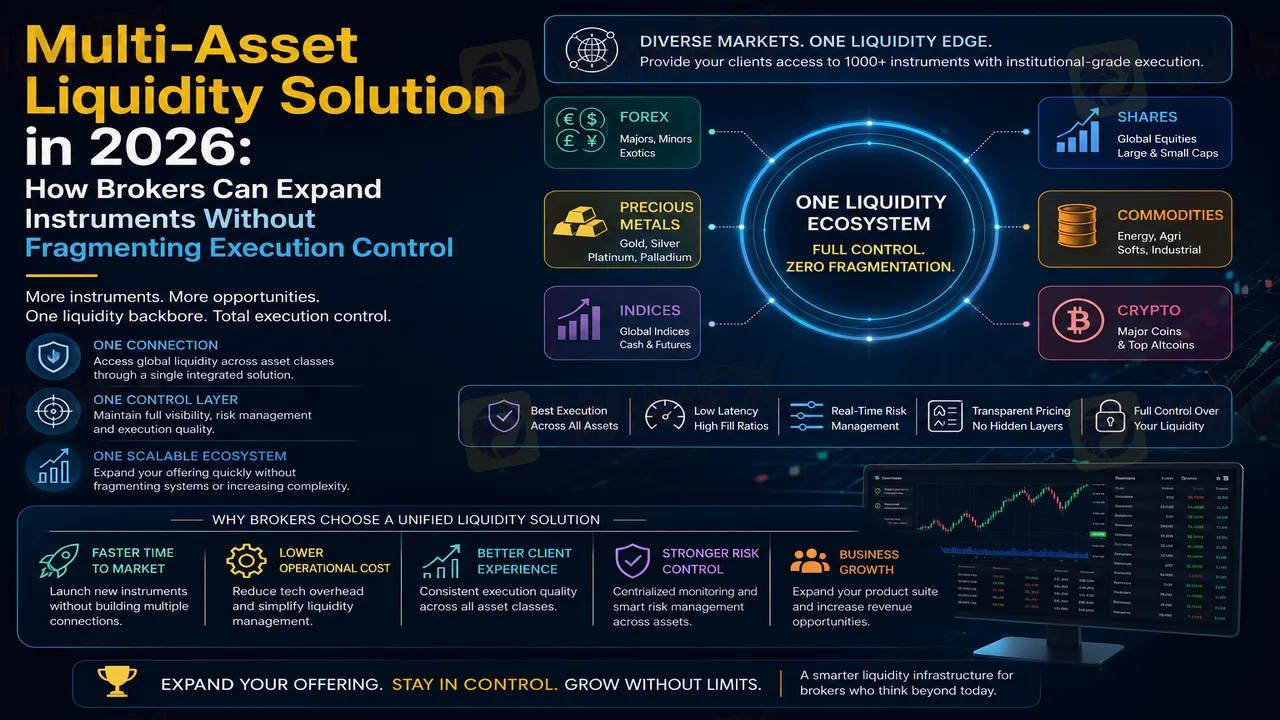
**Editorial and risk notice:** This B2B guide is for brokerage executives, dealing desks, operations, technology, risk, and compliance teams. It is not investment advice, a recommendation of a liquidity provider, or a promise of pricing, execution quality, availability, client growth, or trading outcomes. Confirm legal permissions, product scope, contractual responsibilities, and local obligations with qualified advisers and counterparties.
Adding new instruments is often framed as a product decision: add gold, an index, an energy CFD, or another currency pair. For a broker, it is more accurately an operating decision. Each new asset class can introduce a different trading calendar, contract specification, liquidity pattern, margin treatment, risk limit, data source, and client question. A multi-asset liquidity solution only creates scale when those differences remain controllable.
 Contents
Editorial illustration: a broker-owned control hub coordinating FX, CFD, commodity, and index market streams through shared routing and risk controls.
The technical connection may look unified while the service beneath it is not. A forex CFD liquidity setup can include different market-data, counterparties, trading hours, corporate-action handling, and liquidity behaviour from a commodity or index product. The broker needs a control model that shows where the service is shared and where it must differ.
| Control area | Shared broker control | Product-specific control |
| Instrument master | symbol owner, approval, client terms | contract size, expiry, trading hours, holiday schedule |
| Pricing and routing | filter policy, route governance, change approval | depth, reference data, session rules, venue availability |
| Risk | escalation, limit-change authority, monitoring | margin, concentration, volatility, exposure rules |
| Records | identifiers, timestamps, retention, reconciliation | fee/adjustment fields and product events |
| Client support | event language, incident ownership, complaint process | product warnings and market-closure explanation |
**Common mistake:** treating an additional asset class as a simple symbol upload. If product terms, price sources, risk controls, and support wording do not agree, the broker has created an execution gap.
Ask for written answers that separate a marketing claim from an operational commitment:
This is illustrative, not a customer case study. A broker adds FX, commodities, indices, and CFDs to one platform. During a public holiday, an index market closes while FX remains active and a commodity feed changes its session state. The platform labels all three events differently; support cannot tell which message is correct. The broker resolves this by creating a product-event vocabulary, a single customer-notice owner, and a rule that each instrument's calendar and status must be validated before launch.
A practical multi-asset model combines central controls with product-aware configuration. Central functions should own change governance, monitoring, audit trail, vendor escalation, and client-communication approval. Product owners should define the specific contract, pricing windows, risk limits, fees, and exception handling for their instruments.
The FCA's operational-resilience guidance offers a useful general discipline: map the people, processes, technology, information, and third parties required for an important service, and retain responsibility for the resulting risk. A broker should be able to follow a client order from product setup to price, route, execution status, fee, record, and support message.
Need the Multi-Asset Liquidity implementation checklist? Dapatkan Checklist via WhatsApp
| Test | Evidence | Why it matters |
| Product calendar | approved sessions, holidays, halts, notices | avoids wrong availability messages |
| Price and depth | samples by instrument, size, and session | tests executable service, not a headline quote |
| Margin and limits | approval, alerts, client/platform handling | tests risk behaviour under stress |
| Corporate/product events | reference-data change and correction record | prevents symbol/contract confusion |
| Route outage | failover, incident owner, recovery result | proves continuity and accountability |
| Reconciliation | orders, fills, fees, adjustments, balances | supports reporting and disputes |
Cost modelling should include connection, market data, technology, product configuration, professional services, monitoring, reconciliation, support training, incident work, and contingency. Model a base case, a growth case with new instruments or regions, and a stress case with a market disruption or a product correction.
For an Indonesian Pialang Berjangka, a multi-asset connection is not evidence that every product, client flow, promotion, or operational model is authorised. Confirm current requirements with the legal and compliance team. Keep Bahasa Indonesia product disclosures, risk notices, order-status labels, payment communications, KYC/onboarding explanations, and complaint workflows aligned to the actual records and terms. A single platform view should not mask separate permissions or different client obligations.
| Period | Objective | Evidence before the next gate |
| Days 0-20 | Define assets, client segments, policy, and dependencies | product matrix, legal review, control map |
| Days 21-45 | Validate provider scope, data, cost, and risk rules | contracts, samples, fee model, approval matrix |
| Days 46-70 | Configure and test each product boundary | test logs, calendar validation, reconciliation, support scripts |
| Days 71-90 | Limited launch and measured review | monitored results, exception register, go/no-go decision |
It is a set of market-access, pricing, routing, risk, data, and operational capabilities that let a broker support more than one asset class. The actual service depends on the legal agreements, technology, and broker controls.
Possibly, but product coverage alone is not enough. The broker must verify the actual scope, price/route behaviour, calendars, limits, records, fees, and incident responsibilities for each asset class.
Monitor price and fill behaviour, availability, limits, route changes, fees, product events, reconciliation breaks, incidents, and client complaints separately by product while reviewing common service controls together.
The strongest multi-asset liquidity solution is not the one with the longest instrument list. It is the one a broker can operate as one coherent service: product rules are clear, execution evidence is traceable, risks have owners, and client communication remains accurate when markets behave differently.
Want the multi-asset implementation checklist? Daptakan Checklist via WhatsApp
Disclaimer:
The views in this article only represent the author's personal views, and do not constitute investment advice on this platform. This platform does not guarantee the accuracy, completeness and timeliness of the information in the article, and will not be liable for any loss caused by the use of or reliance on the information in the article.

IG review for India in 2026: see the RBI Alert List entry, overseas regulation, login checks, forex limits, and a clear broker safety checklist.

Orbex, a Cyprus-based brokerage entity, has recorded 30 exposure complaints on WikiFX, a leading forex broker regulation inquiry tool, so far. Other review websites have also recorded a healthy number of complaints against the brokerage firm. These complaints largely talk about the alleged profit confiscations by the broker in the name of trading violations, difficulty in accessing fund withdrawals, capital losses due to artificial slippage, etc. In this Orbex review, we have investigated user complaints and provided a regulatory overview of the broker.
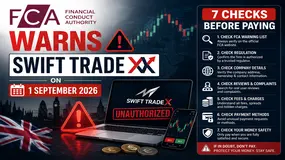
FCA warns Swift TradeX in a notice first published and updated on 1 September 2026. The UK Financial Conduct Authority says the firm may be providing or promoting financial services without permission, is not authorised, and may be targeting people in the UK. The notice names the website swifttradexai.com, a Worcester address and a UK telephone number, but also cautions that unauthorised businesses may use incorrect or borrowed contact details. The confirmed issue is authorisation status—not a court finding about every transaction. Anyone considering a payment should stop, verify the firm independently, and avoid using contact information supplied by the platform itself.

ThinkMarkets review for India: check the RBI Alert List, overseas entities, regulation, login security, forex rules, costs, withdrawals, and leverage risk.
WikiFXWikiFXWikiFXWikiFXWikiFXWikiFXWikiFXWikiFXWikiFXWikiFX