

Global Broker Regulation Inquiry App
About WikiFX
English
简体中文
繁體中文
English
Pусский
日本語
ภาษาไทย
Tiếng Việt
Bahasa Indonesia
Español
हिन्दी
Filippiiniläinen
Français
Deutsch
Português
Türkçe
한국어
العربية
اردو


Why Revenge Trading Will Quickly Destroy Your Forex Account

WikiFX
|


Abstract:Revenge trading happens when a trader tries to immediately win back a recent loss, leading to emotional and reckless decisions. This guide explores the psychological traps that beginners fall into, the danger of using heavy position sizes, and practical ways to step away from the screen before blowing an account.
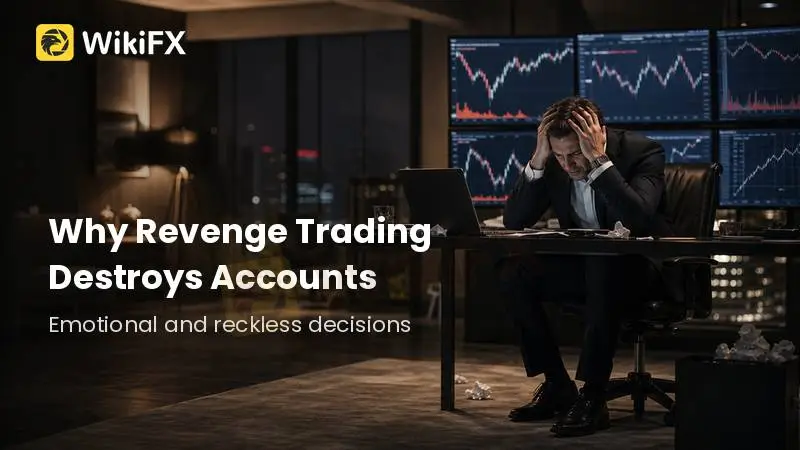
For many new Forex traders in India, hitting a stop-loss can feel like a personal insult. Instead of walking away, the immediate reaction is often to open a new trade—sometimes with a larger lot size—to quickly recover the lost capital.
This dangerous habit is known as “revenge trading.” It is driven by frustration rather than strategy, and it is one of the fastest ways to empty a trading account.
A forex market represents a continuous exchange of buying and selling pressure. Making a mistake is normal. However, how you react to it determines whether you will survive long enough to become a consistent trader.
 Contents
What Exactly is Revenge Trading?
Revenge trading occurs when you rush to recover from a losing position by immediately opening a new one. Often, a trader will instantly enter a reverse position, assuming the market simply “has to” go the other way now.
The provided market material highlights a critical rule: never trade with an anxious desire to turn your luck around. When you try to guess the market out of anger, you are treating Forex like a game of chance. Missing a trading opportunity entirely is always better than chasing a bad trade and generating further losses.
A new position should only be opened when the market presents a clear, logical signal—not because you feel cheated by your last trade.
Signs That You Are Losing Control
Recognizing when you are getting too emotional—often referred to as being “on tilt”—is a necessary survival skill. The psychological battle in Forex is usually against yourself, not the market.
You are likely falling into a revenge trading mindset if you experience the following:
- Irrational Imagination: Your head fills with aggressive, unrealistic scenarios of how the market will suddenly spike in your favor.
- Ignoring the Trend: You start fighting the overall downward or upward trend, stubbornly believing you can pick the exact bottom or top.
- Numbness to Risk: You stop calculating your stop-loss distance and start trading purely on a desperate “gut feeling.”
- Overtrading: You place multiple rapid-fire trades in a single session, abandoning your daily rules.
When greed for a quick recovery and the fear of losing more take over, your independent judgment vanishes.
The Danger of Trading With Heavy Positions
Your position size directly controls your emotional state.
If you place a heavy trade relative to your account size, every tiny point of movement creates massive financial pressure. When a heavy trade turns negative, the panic is intense. You might close the trade prematurely out of fear, only to watch it reverse back in your favor, which triggers even more frustration and revenge trading.
Keeping your position size light allows you to survive normal market fluctuations without losing your mind. If a light trade hits your stop-loss, it feels like a small paper cut. You can easily accept the small loss, evaluate the chart, and wait for the next setup.
Trade Only With Capital You Can Afford to Lose
Another major cause of revenge trading is the source of your funds.
Forex trading must only be done with spare capital. If an Indian beginner is trading with money needed for rent, living expenses, or emergency funds, the psychological burden is unbearable. Operating from a place of financial desperation creates a toxic mindset. When you cannot afford to lose capital, a single losing trade will almost always trigger a frantic, emotional attempt to win it back.
Practical Ways to Break the Cycle
If you find yourself staring at a closed, losing trade with your finger hovering over the “Buy” or “Sell” button, you need to break the cycle immediately.
The most effective strategy is to simply walk away. Taking a temporary break from the charts—whether for a few hours or a few days—gives your brain time to clear. It helps you remember that the market will still be there tomorrow.
Additionally, beginners often try to justify a loss by blaming the broker, claiming the platform deliberately hunted their stop-loss. In reality, stop-losses are triggered by normal volatility or tight placement, though traders should still verify broker regulation, execution quality, and trading conditions.
If broker choice is part of your anxiety, beginners can calmly check a broker's license status and regulatory background through due-diligence tools such as WikiFX before depositing more funds, rather than aggressively trading against the market.
Accept that losses are a normal business expense in Forex. The market does not need to agree with your opinion. Stepping away to protect your remaining capital is the smartest trade you can make on a bad day.
Disclaimer:
The views in this article only represent the author's personal views, and do not constitute investment advice on this platform. This platform does not guarantee the accuracy, completeness and timeliness of the information in the article, and will not be liable for any loss caused by the use of or reliance on the information in the article.
WikiFX Broker
Latest News
Alpari Review 2026: Official Warnings and High Complaint Patterns
WikiFXM4Markets Broker Review: Regulation, Licenses and WikiScore Analysis
WikiFXOver RM102 Million Crypto Seized in Romance Scam Crackdown
WikiFX"High Inspirations" Mastermind Disappears as $25 Billion Investment Scheme Collapses
WikiFXRupee Hits Two-Month Low as Oil Surges Past $95
WikiFXWhy RBI Sold $6.1 Billion in Forex Markets in May
WikiFXCNMV Red-Flags 9 Unauthorised Investment Platforms
WikiFXOrder Execution: What Discretionary Latitude Means for Your Trades
WikiFXScammed Twice: Recovery Fraud Takes Advantages of Victims Again
WikiFXWhy Prices Rush Back to Fill Gaps: Liquidity Voids Explained
WikiFX