

عالمی بروکر ریگولیشن چیک کرنے والا ایپ
WikiFX
اردو
简体中文
繁體中文
English
Pусский
日本語
ภาษาไทย
Tiếng Việt
Bahasa Indonesia
Español
हिन्दी
Filippiiniläinen
Français
Deutsch
Português
Türkçe
한국어
العربية
اردو
Why Most Retail Traders Fail: What the Numbers Reveal

خلاصہ۔:Retail trading data shows why so many traders quit or lose money, from short survival periods and high costs to overconfidence, emotional decisions, and poor risk control.
The promise of quick profits draws large numbers of people into short-term trading every year. Yet the reality is far less forgiving. Most new traders remain active for only a limited period, and very few manage to generate reliable profits after fees and other trading costs.
The problem is not simply a lack of market knowledge. Trading records and behavioral studies point to a wider combination of unrealistic expectations, emotional decision-making, excessive activity, and weak risk management.
 فہرست
فہرستHow Long Do Most Traders Stay in the Market?
Many traders enter the market expecting rapid financial gains. Once they face losses, transaction costs, and the pressure of making decisions in real time, those expectations often change quickly.
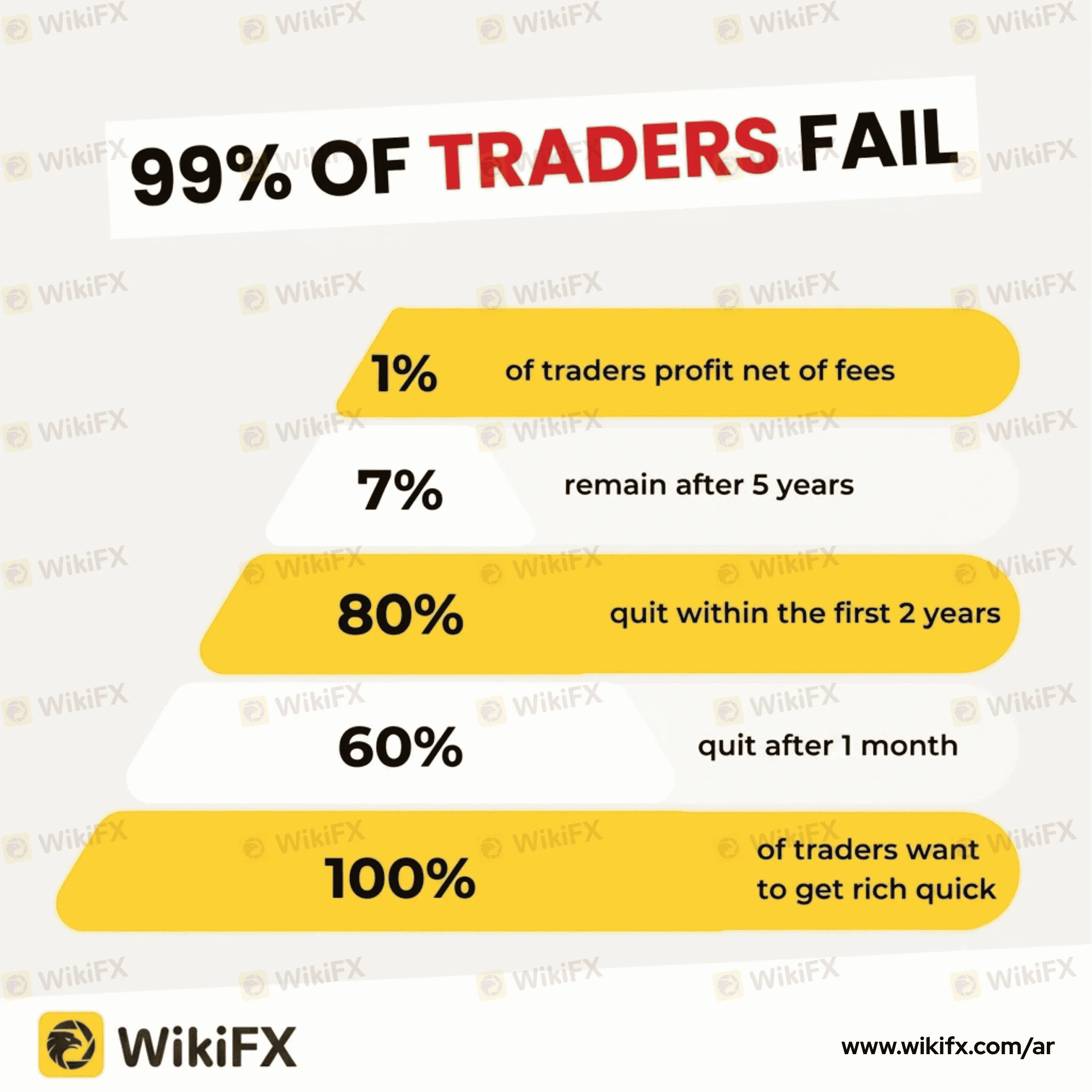
The survival figures are striking:
- Around 60% of new traders leave within their first month.
- About 80% stop trading within two years.
- Only 7% remain active after five years.
- Roughly 1% achieve sustained and predictable profits after transaction costs.
Taken together, these numbers suggest that close to 99% of traders fail to reach consistent long-term profitability.
Some traders continue despite years of poor results. Research has found cases in which individuals remained active even after recording negative performance for as long as a decade. Instead of treating repeated losses as a reason to review their approach, they continued trading without making meaningful changes.
Why Profitable Traders Are So Rare
A trader may have a profitable day, week, or month without having a reliable trading method. Short-term gains can come from favorable market conditions, excessive risk, or simple luck.
Consistent profitability is much harder.
Only a small group of traders appears capable of producing repeatable returns after commissions, spreads, slippage, and other costs are deducted. In an average year, profitable day traders account for around 1.6% of all participants, although they generate approximately 12% of total day-trading activity.
Successful traders also tend to increase their activity when their results improve. The difference is that their decisions are usually supported by a tested process rather than a reaction to a recent win.
The Cost of Trading Too Often
Frequent trading creates a major obstacle that many beginners underestimate: costs accumulate.
A single commission or spread may appear small, but the effect becomes significant when repeated across dozens or hundreds of trades. Financing charges, slippage, and unfavorable execution can add further pressure.
The average individual investor underperforms a market index by around 1.5% per year. Among highly active traders, the gap widens to approximately 6.5% annually.
This does not mean that every active trader must lose money. It means that each trade must earn enough to cover both the market risk and the cost of execution. When a trader enters positions without a clear advantage, higher activity often leads to faster capital erosion.
The Disposition Effect: Cutting Winners and Holding Losers
One of the most common trading mistakes is known as the disposition effect.
Traders often close profitable positions too quickly because they want to secure the gain. At the same time, they keep losing positions open because closing them would mean accepting that the trade was wrong.
Research shows that traders sell winning positions at a rate 50% higher than losing ones. Around 60% of completed sales involve profitable positions, while only 40% involve losing positions.
This creates an unhealthy pattern: small profits are realised early, while losses are allowed more room to grow.
The decision is usually emotional. Taking profit feels rewarding, while closing a loss feels like failure. Without clear exit rules, traders may repeatedly make choices that protect their emotions rather than their capital.
Recent Wins Can Lead to Overconfidence
A successful trade often encourages more trading.
Individual investors tend to become more active after their most recent trades produce a profit. They may increase position size, lower their entry standards, or take risks they would normally avoid.
The problem is that a short winning streak does not necessarily prove that a strategy works. A trader may simply be benefiting from a strong trend or temporary market conditions.
When confidence rises faster than skill, one bad position can erase several earlier gains.
Past results also influence which assets traders choose to revisit. Investors are more likely to repurchase a stock they previously sold for a profit than one they sold at a loss. The earlier emotional experience can influence the new decision, even when current market conditions are completely different.
When Trading Starts to Resemble Gambling
Not every trader approaches the market as a serious financial activity.
Some participants are attracted to the excitement, uncertainty, and possibility of a large payoff. Their behavior resembles lottery participation more closely than disciplined investing.
Researchers have observed that retail trading activity declines when unusually large lottery jackpots become available. Trading in Taiwan also fell by about 25% after a lottery was introduced in April 2002.
These patterns suggest that some individuals use both trading and lotteries to pursue the same goal: a small chance of achieving a dramatic financial gain.
Lower-income individuals may spend a larger share of their income on lottery products, particularly when their financial position deteriorates. Investors with a wide gap between their current circumstances and financial ambitions may also place more money into high-risk, lottery-style assets.
Across income groups, individuals displaying gambling-like behavior tend to underperform those who take a more measured approach.
The Problem With “Trading to Learn”
Many beginners believe that losing money is simply part of learning how to trade.
Experience is important, but repeatedly placing unplanned trades does not automatically build skill. Trading without a tested method, defined risk limits, or proper records may only reinforce bad habits.
Using live capital without a clear learning process is similar to repeatedly playing a game of chance and expecting losses alone to produce expertise.
Useful experience comes from reviewing decisions. Traders need to know why a position was opened, how much was at risk, what would invalidate the trade, and whether the plan was followed.
Without this information, it becomes difficult to separate poor execution from a weak strategy or unfavorable market conditions.
Familiarity Can Create Concentration Risk
Investors often place more money into industries they know well, including the sector in which they work.
This may feel safer because the companies and business models are familiar. In practice, it can create excessive concentration.
When both employment income and investments depend on the same industry, a downturn may affect a persons salary, job security, and portfolio at the same time.
Investors who hold a wider range of stocks and funds are generally better positioned to benefit from diversification. Traders with higher cognitive ability have also been found to hold more mutual funds and a larger number of stocks, reducing their dependence on a single outcome.
Diversification cannot prevent every loss, but it can limit the impact of one poor decision or one weak sector.
What Separates a Process From a Gamble?
The difference is not whether a trade makes money. A poorly planned trade can win, while a carefully managed position can lose.
The difference lies in the process.
A disciplined approach normally includes:
- a clear reason for entering the market;
- a fixed amount of capital at risk;
- an exit point for both profit and loss;
- realistic expectations;
- records of previous trades;
- and regular performance reviews after costs.
Traders also need to control the urge to increase activity simply because they are bored, frustrated, or excited by recent results.
More trades do not necessarily create more opportunities. In many cases, they only create more chances to make mistakes.
Final Thoughts
The numbers show how difficult long-term retail trading can be. Most participants leave within a relatively short period, while only a very small percentage achieve steady profits after costs.
The reasons are often repeated across different groups of traders: overconfidence after recent gains, holding losing positions for too long, taking profits too early, excessive trading, and treating the market as a shortcut to wealth.
Trading requires patience, risk control, and a method that can be tested over time. Those who approach it mainly for excitement or rapid returns are more likely to make emotional decisions and expose their capital to unnecessary losses.
A trader cannot control the market, but they can control position size, trading frequency, preparation, and the way losses are managed.
About WikiFX
WikiFX provides information on brokers, including regulatory records, licence details, risk notices, and user feedback. Traders can use the platform as a reference when conducting due diligence before choosing a financial service provider. The information provided is for educational and informational purposes and does not constitute investment advice.

ڈس کلیمر:
یہ مضمون صرف مصنف کی ذاتی رائے پر مبنی ہے، یہ پلیٹ فارم کی سرمایہ کاری کی مشورہ نہیں ہے۔ پلیٹ فارم مضمون کی معلومات کی درستگی، مکملیت اور بروقت ہونے کی کوئی ضمانت نہیں دیتا، اور مضمون کی معلومات پر اعتماد یا استعمال سے ہونے والے کسی بھی نقصان کی ذمہ داری قبول نہیں کرتا۔
