

Global Broker Regulation Inquiry App
About WikiFX
English
简体中文
繁體中文
English
Pусский
日本語
ภาษาไทย
Tiếng Việt
Bahasa Indonesia
Español
हिन्दी
Filippiiniläinen
Français
Deutsch
Português
Türkçe
한국어
العربية
اردو


Your Perfect Entry Could Be a Bad Trade: Judge Worthiness First

WikiFX
|


Abstract:An entry point that looks right does not guarantee a trade worth taking. Learn to separate the excitement of a perfect setup from the real question: is the overall risk, context, and probability on your side? A simple self-observation exercise can improve decision-making.
 Contents
The Trap of the Perfect Entry
Youve done your homework. The chart shows a textbook double bottom, and price is bouncing off a support level, a line where buyers have historically stepped in. You enter, only to see the market reverse and hit your stop.
Frustration sets in. You tell yourself, “The entry was right, the market is wrong.” But was the trade really worth taking?
An entry point is simply the price at which you open a trade. The mistake many newcomers make is treating a clean entry signal as the only measure of a good trade. Picture this hypothetical situation: EUR/USD is trading at 1.1390, right at a well-known support level.
You decide to go long, placing a stop‑loss, an order to automatically exit if the price moves against you, at 1.1370, and a take‑profit at 1.1450. That gives you a risk of 20 pips and a potential reward of 60 pips. (A pip is a unit of price movement in forex, usually the fourth decimal place for most pairs.) So the risk/reward ratio appears to be 1:3.
It looks neat on paper. Yet the reason the trade fails might have nothing to do with the entry point. Maybe a major central bank announcement is scheduled a few hours later, or the broader market trend is actually downward. The entry point felt good, but the trade was never strong enough to justify the risk. A single puzzle piece, however perfect, does not complete the whole picture. You need to evaluate the entire environment before deciding.
The Psychological Pull: Why We Overvalue Entry Points
Our brains love patterns. Finding a precise turning point triggers a small rush of excitement, a feeling that you have “cracked the code.” This dopamine hit can make you overlook everything else. FOMO, or the fear of missing out, pushes you to act quickly so you do not miss the move.
As a result, you become fixated on being right about the direction, rather than evaluating the trades overall structure. This fixation ignores two essential components: risk/reward ratio and context. The risk/reward ratio compares the amount you are willing to lose with what you hope to gain. In the hypothetical EUR/USD trade above, the ratio is 1:3 (20 pips risked for 60 pips target). That ratio appears attractive, but it means nothing if the probability of reaching the target is very low because of an upcoming news event.
Context includes factors like economic announcements, market sentiment, and volatility, how much and how fast prices change. A solid entry loses value when the trading environment is against you. These elements can override even the cleanest chart pattern.
Beginner traders often confuse a good entry with a good trade. A good trade is one where the setup, the risk/reward, and the market context all align. When you feel the urge to enter simply because the chart looks perfect, pause and reflect: are you chasing the thrill of the entry, or have you checked everything else?
A Simple Self-Observation Exercise: Is the Trade Worth Your Attention?
You do not need complex formulas to improve your decision‑making. A short mental exercise can nudge you away from impulsive entries. Instead of acting on the first impulse, many disciplined traders keep a journal where they write down a few notes before considering any trade. Here is an example of the kind of questions they might ask themselves:
- What would my stop‑loss and take‑profit be if I entered? (This clarifies potential risk and reward in price terms.)
- What risk/reward ratio does that imply? In the earlier hypothetical EUR/USD example, a 20‑pip stop and 60‑pip target gave a 1:3 ratio.
- Why might this trade fail? List at least one or two reasons outside the entry signal. Could an economic release reverse the move? Is the overall trend pointing the other way?
- Given those failure modes, does this setup still make sense? This is the worthiness question. A ratio alone does not guarantee a winning trade; context matters.
This thought process shifts the focus from “Will I be right?” to “Is this situation worth engaging with?”. Over time, patterns in your own behaviour might emerge. You may notice that you often consider entries right before news events, when probabilities are hardest to estimate. That insight can help refine your approach without anyone telling you when to trade.
Thinking this way is not about predicting the future. It is about building a habit of stepping back. The difference between a gambler and a disciplined trader is not the entry point, but the ability to say “not now” when the trade lacks merit.
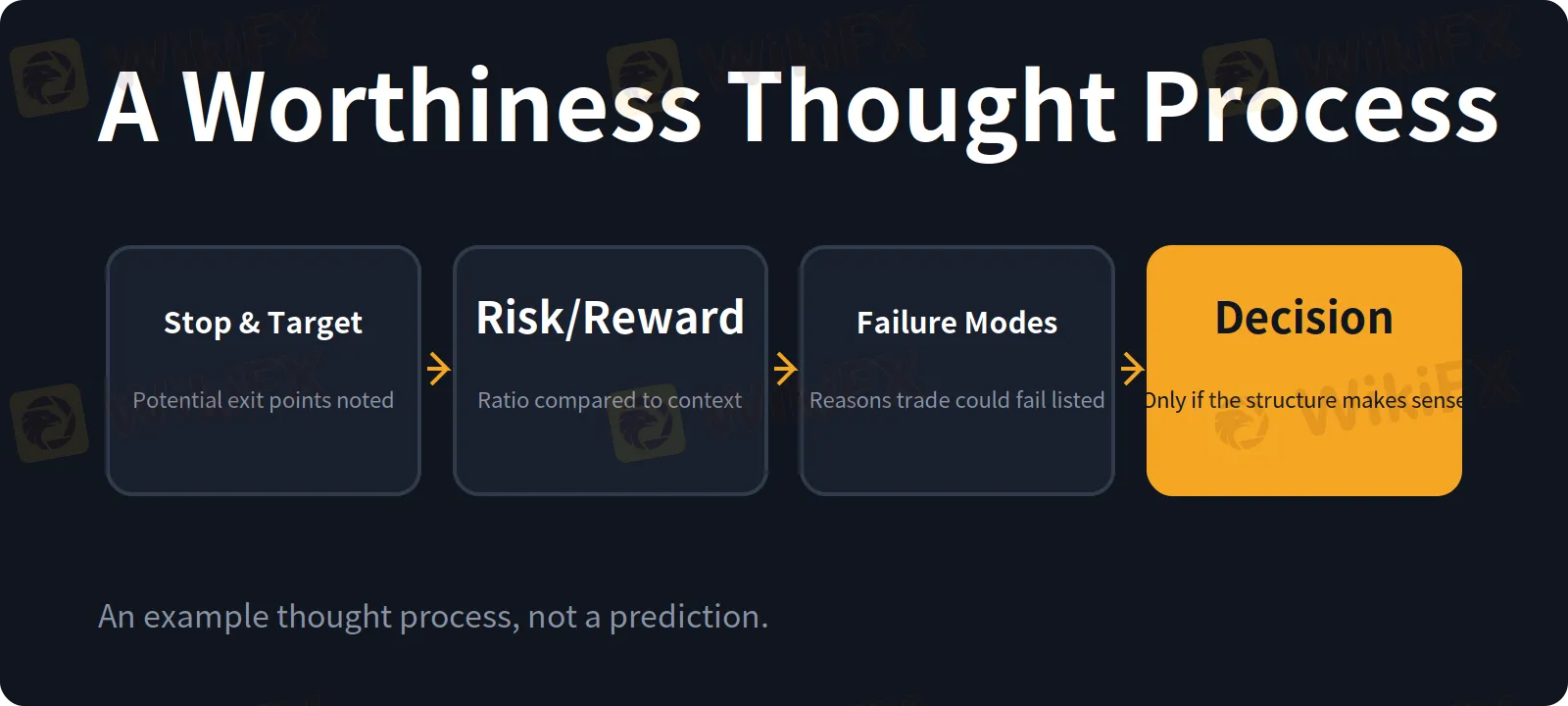
A self-observation exercise before considering a trade.
Disclaimer:
The views in this article only represent the author's personal views, and do not constitute investment advice on this platform. This platform does not guarantee the accuracy, completeness and timeliness of the information in the article, and will not be liable for any loss caused by the use of or reliance on the information in the article.
WikiFX Broker
Latest News
Kudotrade Review 2026: Reported Slippage & Trade Execution Issues You Should Know
WikiFXEURUSD | Demand Zone Holding, Bulls Eyeing Higher Resistance
WikiFXEUR/USD: Bearish Structure Shift
WikiFXFxPro Opens Five CFDs To Weekend Trading
WikiFXValutrades Rejects Exit Rumors Amid Client Review
WikiFX1MDB Recovery Still Leaves RM20 Billion Burden
WikiFXMalaysia Pursues RM4.2 Billion Claim Against Singapore's DBS Bank
WikiFX